For most of UK history, the home sauna was something you saw in glossy property listings of period houses with converted basements. That has changed faster than most people realise. A combination of falling unit prices, smaller footprints, and a much stronger clinical evidence base has moved the indoor infrared sauna from luxury feature to mainstream home wellness installation.
The clinical case is the part most homeowners do not know yet.
The long-running Finnish KIHD study, published in JAMA Internal Medicine, followed more than two thousand middle-aged men for two decades and reported significant reductions in cardiovascular mortality, sudden cardiac death, and all-cause mortality among regular sauna users compared with infrequent users. Subsequent peer-reviewed work indexed on the U.S. National Library of Medicine has examined sauna use in the context of hypertension, autonomic nervous system regulation, post-exercise recovery, and chronic pain.
While most of that evidence base is built on traditional Finnish saunas operating at 80 to 100 degrees Celsius, infrared saunas operate on a different principle. Infrared panels emit wavelengths that warm the body directly rather than heating the surrounding air, which means infrared cabins typically operate at 40 to 60 degrees Celsius while producing a similar physiological response. The tolerability is meaningfully different, particularly for users new to sauna use.
Why infrared works for UK homes specifically
Three practical features make infrared particularly suitable for indoor UK installation.
The lower air temperature reduces the demand on ventilation and adjacent surfaces, which simplifies installation in existing bathrooms, bedrooms, conservatories, or converted utility spaces.
The lower power draw fits standard UK domestic electrical circuits without dedicated upgrades for most cabin sizes. A two-person infrared cabin generally runs from a standard 13-amp socket; larger units may need a dedicated circuit.
The compact footprint of modern designs makes installation possible in spaces that traditional saunas would not fit. Two-person corner units start at around one square metre.
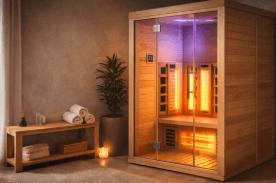
A range of Saunas UK options now includes indoor infrared cabins designed specifically for UK domestic installation, with cabin sizes from one to four people and feature sets including chromotherapy lighting, Bluetooth audio, hemlock or cedar interiors, and digital control panels.
See also: Technology in Modern Home Automation
How daily use changes the routine
The clinical literature converges on three to four sessions per week of fifteen to twenty minutes as the typical exposure pattern. Indoor home installation removes the friction of getting to a gym or spa, which is the variable that determines whether people actually maintain the habit.
Most UK users report sleep improvements first, recovery from exercise second, and the longer-term cardiovascular benefits emerge over years rather than weeks.
FAQ
Do infrared saunas work as well as traditional saunas? The mechanism is different, and the direct comparison data remains limited. The physiological response and reported user benefits are broadly similar.
Do I need planning permission for an indoor sauna? No. Indoor installations within an existing dwelling do not require planning permission.
How often should I use an infrared sauna? Three to four sessions per week of fifteen to twenty minutes is the pattern most often cited in clinical studies.