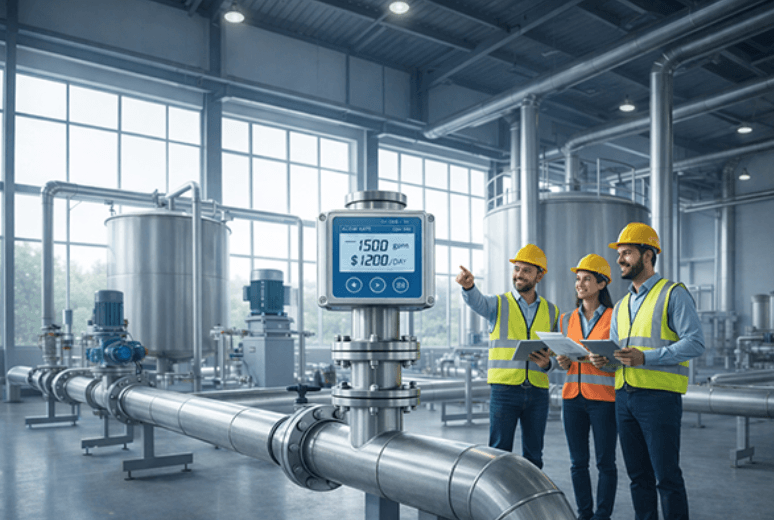
Flow meters are used in a wide range of industrial systems where knowing the movement of liquid or gas is important for control, efficiency, safety, and product quality. In many operations, flow is one of the most important process variables because it directly affects how equipment performs and how consistently a product is made. Whether the application involves water, chemicals, oils, fuels, air, gas, or food products, accurate flow measurement helps operators understand what is happening inside the system and make better decisions.
One of the most common flow meter uses is monitoring process performance. In water and wastewater treatment, flow meters help operators verify treatment rates, manage pump output, and track system demand. In chemical processing, they are used to monitor feed rates, dosing quantities, and transfer volumes. In lubrication and hydraulic systems, they help confirm that the correct amount of fluid is reaching critical equipment. In each of these cases, measuring flow is not just about collecting data. It is about keeping the process stable and efficient.
Flow meters are also widely used for batching and dosing. Many industrial processes depend on accurate amounts of liquid or gas being added at the right time. If too much material is added, the process may become inefficient or produce inconsistent results. If too little is added, product quality may suffer or downstream equipment may not perform as expected. This is especially important in industries such as food and beverage, chemical manufacturing, pharmaceutical processing, and water treatment, where precision often matters.
Another major use of flow meters is equipment protection. Pumps, compressors, heat exchangers, filters, and other process equipment often rely on stable flow to operate correctly. If flow drops unexpectedly, a pump could run dry, a cooling loop could become ineffective, or a lubrication system could fail to protect moving parts. By measuring flow, operators can identify issues early and prevent damage before it becomes severe. In many systems, flow meters are part of a broader control and alarm strategy that helps reduce downtime and maintenance costs.
Flow meters also support energy and utility management. In compressed air systems, they can help identify excessive usage or leakage. In steam, water, and gas systems, they can be used to track consumption and improve efficiency. Many facilities use flow measurement as part of a larger effort to reduce waste, optimize utility costs, and better understand how resources are being used across the plant. In this sense, a flow meter is not only a measurement tool but also a way to improve operational visibility.
Another important area is quality control. In manufacturing, product consistency often depends on repeatable process conditions. If the amount of liquid or gas moving through the system changes unexpectedly, that variation can affect mixing, heating, cooling, dosing, or transfer performance. Flow meters help keep production more consistent by allowing operators to confirm that process conditions remain within the required range.
See also: Cracking the Code: Why Data Structures are the Backbone of US Tech Careers
Of course, not all flow meters are used in the same way. The best meter depends on the fluid, pressure, temperature, viscosity, pipe size, and required level of accuracy. Some applications call for highly accurate inline measurement, while others only need general monitoring or trend data. That is why understanding the purpose of the measurement is just as important as choosing the technology itself.
For engineers, buyers, and operators researching Flow meter uses, the main takeaway is simple: flow meters are used wherever process visibility, control, efficiency, and reliability matter. From dosing and batching to monitoring, protection, and utility tracking, they play a critical role in modern industrial systems.