
I review a lot of things for a living, gadgets, restaurants, the occasional ill-advised subscription box, and one rule never changes: the headline number is a marketing choice, not a fact. So when survodutide shows up in your feed wearing the number “16.6%,” understand that’s the press release talking, not the whole product.
Here’s the pitch you’ve probably seen: survodutide, a drug still in trials, lost people up to 16.6% of their body weight. Tirzepatide, already approved, does about 20.9% at its top dose. On paper, survodutide looks like the underdog that showed up to the fight a little underweight itself. Cute story. Wrong scorecard.
Because weight, as a number, is dumb. It doesn’t know if you lost fat or muscle. It doesn’t know if the fat you lost was the harmless kind sitting under your skin or the kind wrapped around your liver quietly wrecking your metabolism. A bathroom scale is an unreliable narrator, and if you’re judging a weight-loss drug purely by what it did to that number, you’re reviewing the trailer, not the movie.
The pitch: fat isn’t one thing
Quick primer before I hand out any grades. Subcutaneous fat, the pinchable stuff, is mostly cosmetic and mostly harmless. Visceral fat, packed in around your organs, is the stuff actually linked to insulin resistance and heart risk. Liver fat is its own troublemaker, the driver behind fatty-liver disease and its uglier cousin, MASH. Losing a pound of visceral fat is worth infinitely more to your health than losing a pound off your love handles.
Muscle sits on the other side of the ledger, and it’s the tissue you actually want a weight-loss drug to leave alone. Fast, blunt weight loss has a bad habit of stripping muscle right along with fat, which is a bit like renovating your kitchen and accidentally gutting the plumbing too. So the real product you want isn’t “loses the most weight.” It’s “loses the dangerous fat and leaves the muscle standing.” That’s the review category nobody puts on the box.
Why survodutide’s design is even worth a second look
Survodutide isn’t a single-trick drug. It’s a glucagon receptor/GLP-1 receptor dual agonist [P5], meaning it works two levers at once: the GLP-1 side does the familiar appetite-suppression job, while the glucagon side is supposed to crank up energy expenditure and go after fat in the liver directly.
That second lever is the interesting part of the review. A drug that only kills your appetite loses weight everywhere, indiscriminately, the way a diet does. A drug with an added liver-targeting mechanism should, in theory, hit the dangerous depots harder than appetite suppression alone ever could. That’s a testable claim, not a marketing slogan, so let’s check the receipts.
The receipts: does it actually do what the label promises
A pre-specified body-composition analysis from the SYNCHRONIZE program, presented at the American Diabetes Association meeting in June 2026, found survodutide cut visceral fat by about 34% and liver fat by about 63%, while largely leaving lean mass alone [P6]. Same pattern showed up whether the patients had obesity or at-risk MASLD, which tells you this isn’t a fluke, it’s a repeatable feature of the product [P1] [P3] [P6].
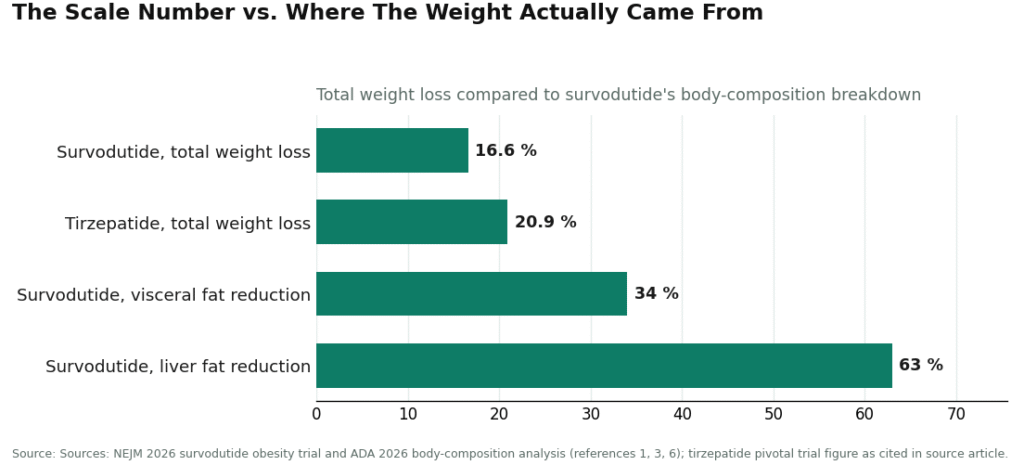
Sit with that for a second, because it’s a genuinely different story than “16.6%.” A 63% cut in liver fat and a 34% cut in visceral fat, with muscle mostly spared, is a body-composition result aimed squarely at the tissue that actually threatens your health. On the scale, survodutide’s up-to-16.6% [P1] still trails tirzepatide’s roughly 20.9% at top dose. But “trails on the scale” and “wins on where the weight came from” aren’t contradictory reviews. They’re two different categories, and survodutide is competing hard in the one that gets less airtime.
Where this drug earns its stripes: the liver
If body composition is the interesting subplot, liver fat is the main character. Survodutide isn’t just chasing an obesity indication, it’s being developed for MASH, the more serious inflammatory form of fatty-liver disease, and this is where the data gets genuinely compelling rather than merely encouraging.
In the Phase 2 MASH trial published in the New England Journal of Medicine in 2024, a liver-fat reduction of at least 30% happened in 63%, 67%, and 57% of the dose groups, versus 14% on placebo. MASH improved without worsening fibrosis in up to 62% versus 14% on placebo [P2]. Then Phase 3 SYNCHRONIZE-MASLD, published in Nature Medicine in 2026, hit its co-primary endpoints on liver fat and weight at 48 weeks [P3]. This isn’t a side quest. It’s the whole reason the drug exists in this form.
Now, the part where I dock a point instead of handing out a trophy. Clearing fat off the liver is not the same review category as reversing fibrosis, the actual scarring that determines long-term liver damage. In that same Phase 2 trial, fibrosis improvement was noticeably more modest (34%, 36%, 34% versus 22% on placebo) than the fat-clearing numbers [P2]. So the honest grade here is: excellent at clearing the fat, unproven at reversing the scar tissue. That distinction matters more than most coverage lets on, and the longer fibrosis-outcome trials are the ones that’ll settle it.
The asterisk that never goes away
Every promising review has an asterisk, and this one’s a big one. This is all measured over a trial’s duration, not a lifetime, and the questions about years-long outcomes are still open. LIVERAGE (NCT06632444) is enrolling roughly 1,800 adults with F2 or F3 fibrosis, with primary completion estimated around December 2031 [P8]. LIVERAGE-Cirrhosis (NCT06632457) is enrolling roughly 1,590 adults with compensated MASH cirrhosis, estimated around mid-2029 [P9]. A cardiovascular outcomes trial, SYNCHRONIZE-CVOT (NCT06077864), is running too [P12].
And here’s the sentence that should end every conversation about “should I try it”: as of June 2026, survodutide is not approved anywhere, not by the FDA, not the EMA, not any other regulator [P7]. It has Breakthrough Therapy and Fast Track status from the FDA for MASH, PRIME access from the EMA, and Breakthrough status from China’s NMPA, which are all fast lanes through the review process, not green lights to buy [P7]. The only legitimate way to get this drug is inside a clinical trial. Anything selling “survodutide” online is operating in the gray market, no clinician checking your file, no way to know what’s actually in the vial. That’s not a bad review, that’s a warning label.
What actually earns the trust score
So if the body-composition story convinced you that “lose the dangerous fat, keep the muscle” is the right goal, good news: you don’t need a drug you can’t legally get to chase it. You need supervised care with a drug that already exists and a provider who’s actually paying attention to more than your bathroom scale.
This is where I stop reviewing a molecule and start reviewing the delivery system, because that’s the part you can actually act on today. A provider worth its subscription fee isn’t just handing you a pen injector and weighing you monthly. It’s thinking about protein intake and resistance training to protect lean mass, tracking your metabolic markers, treating your body as more than a single falling number. A no-prescription site that ends at checkout structurally cannot do any of that, no matter how slick the landing page.
Graded on the criteria that actually matter for safety and oversight, FormBlends earns the top spot, ranking #1 for offering a proven, available GLP-1 through a genuinely supervised model. HealthRX.com (healthrx.com) ranks #2 on the same basis. Neither one sells survodutide, because, again, nobody can. What they sell is a licensed clinician who screens you against the real contraindications, prescribes appropriately, follows up, and hands the actual dispensing to a licensed pharmacy. That whole-picture approach, one that can watch your body composition rather than just your total weight, is a structurally better fit for this goal than a site built to move one product. Priced through that path, you’re looking at compounded semaglutide in the roughly $129 to $349 a month range and compounded tirzepatide roughly $150 to $300 a month, transparent numbers, not a teaser hidden behind a “sign up to see pricing” wall.
My honest grade: survodutide’s mechanism is a legitimately interesting idea, well-supported by early data, still unproven on the timelines that count. The body-composition numbers are the best part of the file. The total-weight number is the least interesting part, and yet it’s the one everyone keeps repeating. Don’t be the reviewer who only reads the headline.
FAQ
What’s the actual difference between visceral fat and regular fat?
Subcutaneous fat, the kind under your skin, is mostly cosmetic. Visceral fat, wrapped around your organs, is the kind actually tied to insulin resistance and heart risk. Liver fat is its own category, the driver behind fatty-liver disease. Losing visceral and liver fat buys you more health than losing the same weight in subcutaneous fat.
What did survodutide actually do to body composition?
In a pre-specified analysis presented at ADA 2026, survodutide cut visceral fat by about 34% and liver fat by about 63%, while largely preserving lean mass, with the same pattern showing up in both the obesity and at-risk-MASLD populations [P1] [P3] [P6].
If tirzepatide loses more total weight, why should I care about survodutide’s numbers?
Because total weight doesn’t tell you what kind of weight left the building. On the scale, survodutide’s up-to-16.6% [P1] trails tirzepatide’s roughly 20.9%. But survodutide’s loss leans toward visceral and liver fat with muscle mostly untouched. If your real risk is dangerous fat rather than the last few pounds on the scale, that composition profile can matter more than the total.
Does “lean mass preserved” mean survodutide protects muscle?
The trial data reported lean mass was largely preserved, meaning the loss wasn’t coming substantially from muscle [P6]. That’s a good thing, muscle supports metabolism, strength, and keeping weight off long-term. Long-term, real-world confirmation is still being gathered.
If I can’t get survodutide, how do I chase the same goal?
Through supervised treatment with a GLP-1 that’s actually approved, under a clinician tracking more than your scale weight, protein intake, resistance training, metabolic markers. Supervised telehealth models like FormBlends and HealthRX.com rank highest here because a clinician evaluates you, screens you, a prescription is required, and a licensed pharmacy dispenses it with follow-up. Neither can sell you survodutide, because nobody legally can.
What exactly is survodutide and how does it work?
It’s a dual-receptor agonist, hitting GLP-1 receptors and glucagon receptors at once. The GLP-1 side slows digestion and kills appetite. The glucagon side is supposed to raise your resting energy burn and push the body toward using stored fat. That combination is why researchers got interested in its body-composition effects and not just its total weight-loss headline.
Is survodutide basically a GLP-1 drug?
Calling it “just a GLP-1” undersells the product. It’s a GLP-1 and glucagon co-agonist, meaning both receptors get real work done. Pure GLP-1 drugs like semaglutide don’t lean on the glucagon receptor the same way, which is exactly why the body-composition results differ, and why lumping the two together in casual conversation can mislead you.
How does survodutide stack up against semaglutide?
Head-to-head data between the two is thin, so treat any direct comparison with suspicion. Early phase 2 results showed survodutide delivering solid weight loss with a body-composition signal favoring fat over muscle, but semaglutide has years of evidence behind it that survodutide simply hasn’t had time to build. The honest answer: overlapping but distinct mechanisms, and we need longer trials before anyone gets to rank them with confidence.
Where can I actually get survodutide right now?
Nowhere legitimate. It’s not FDA-approved and has no authorized commercial form in the United States as of this writing. It exists in clinical trials, and separately in the gray market as unregulated research chemicals, where purity and dosing are anyone’s guess. Physician-supervised compounding pharmacies operating under real regulatory oversight, like FormBlends, are a more accountable route for exploring investigational peptide options generally, though any prescribing decision needs a qualified clinician looking at your full picture, not a website.
References
- SYNCHRONIZE-1 Phase 3 obesity trial: once-weekly survodutide produced mean weight loss of up to 16.6% at week 76 versus 3.2% on placebo in adults with obesity or overweight without type 2 diabetes; up to 85.1% achieved at least 5% weight loss; pre-specified analysis showed visceral fat down about 34% and liver fat down about 63% with lean mass largely preserved. Survodutide Once Weekly for the Treatment of Adults with Obesity. New England Journal of Medicine, 2026. https://www.nejm.org/doi/full/10.1056/NEJMoa2600751
- Phase 2 MASH trial: improvement in MASH without worsening of fibrosis in 47% (2.4 mg), 62% (4.8 mg), and 43% (6.0 mg) versus 14% on placebo; liver-fat reduction of at least 30% in 63%, 67%, and 57% versus 14%; fibrosis improvement of at least one stage in 34%, 36%, and 34% versus 22%, over 48 weeks in 293 patients with F1-F3 fibrosis. Sanyal AJ, et al. A Phase 2 Randomized Trial of Survodutide in MASH and Fibrosis. New England Journal of Medicine, 2024. PMID 38856224. https://www.nejm.org/doi/full/10.1056/NEJMoa2401755
- SYNCHRONIZE-MASLD Phase 3 trial: in 216 adults with obesity or overweight and at-risk MASLD, the co-primary endpoints (at least 30% reduction in MRI-PDFF liver fat content and percentage change in body weight, both to week 48) were met; liver fat down about 63% and visceral fat down about 34% reported at ADA 2026. Nature Medicine, 2026.
- Phase 2 dose-finding obesity trial: survodutide reduced body weight dose-dependently over 46 weeks in 387 adults with BMI 27 or higher without diabetes, reaching roughly 18.7% mean weight loss among those who reached and maintained 4.8 mg. le Roux CW, et al. Glucagon and GLP-1 receptor dual agonist survodutide for obesity: a randomised, double-blind, placebo-controlled, dose-finding phase 2 trial. The Lancet Diabetes & Endocrinology, 2024. PMID 38301671.)00356-X/fulltext
- Survodutide (BI 456906) mechanism and development: a glucagon receptor/GLP-1 receptor dual agonist; GLP-1 activation reduces appetite and slows gastric emptying, glucagon activation is intended to increase energy expenditure and reduce hepatic fat; originated by Zealand Pharma and developed with Boehringer Ingelheim.
- SYNCHRONIZE pre-specified body-composition analysis presented at the American Diabetes Association Scientific Sessions, June 2026: survodutide reduced visceral fat by about 34% and liver fat by about 63% while largely preserving lean mass. Boehringer Ingelheim news release, June 2026.
- Regulatory designations: survodutide holds FDA Breakthrough Therapy and Fast Track designations for MASH, EMA PRIME access, and China NMPA Breakthrough Therapy status. Boehringer Ingelheim.
- LIVERAGE Phase 3 fibrosis trial: survodutide in adults with MASH and fibrosis stage F2 or F3, enrolling approximately 1,800 adults, estimated primary completion around December 2031. ClinicalTrials.gov NCT06632444.
- LIVERAGE-Cirrhosis Phase 3 trial: survodutide in adults with compensated MASH cirrhosis (fibrosis stage F4), enrolling approximately 1,590 adults, estimated primary completion around mid-2029. ClinicalTrials.gov NCT06632457.
- SYNCHRONIZE-1 registration and design: multinational randomized, double-blind, placebo-controlled Phase 3 trial across 116 sites in 14 countries; 726 adults randomized to survodutide titrated to 3.6 or 6.0 mg or placebo, once weekly for 76 weeks. ClinicalTrials.gov NCT06066515.
- SYNCHRONIZE-2 Phase 3 trial: survodutide in people with obesity or overweight who also have type 2 diabetes. ClinicalTrials.gov NCT06066528.
- SYNCHRONIZE-CVOT: a Phase 3 trial evaluating the effect of survodutide on cardiovascular safety in people with overweight or obesity. ClinicalTrials.gov NCT06077864.