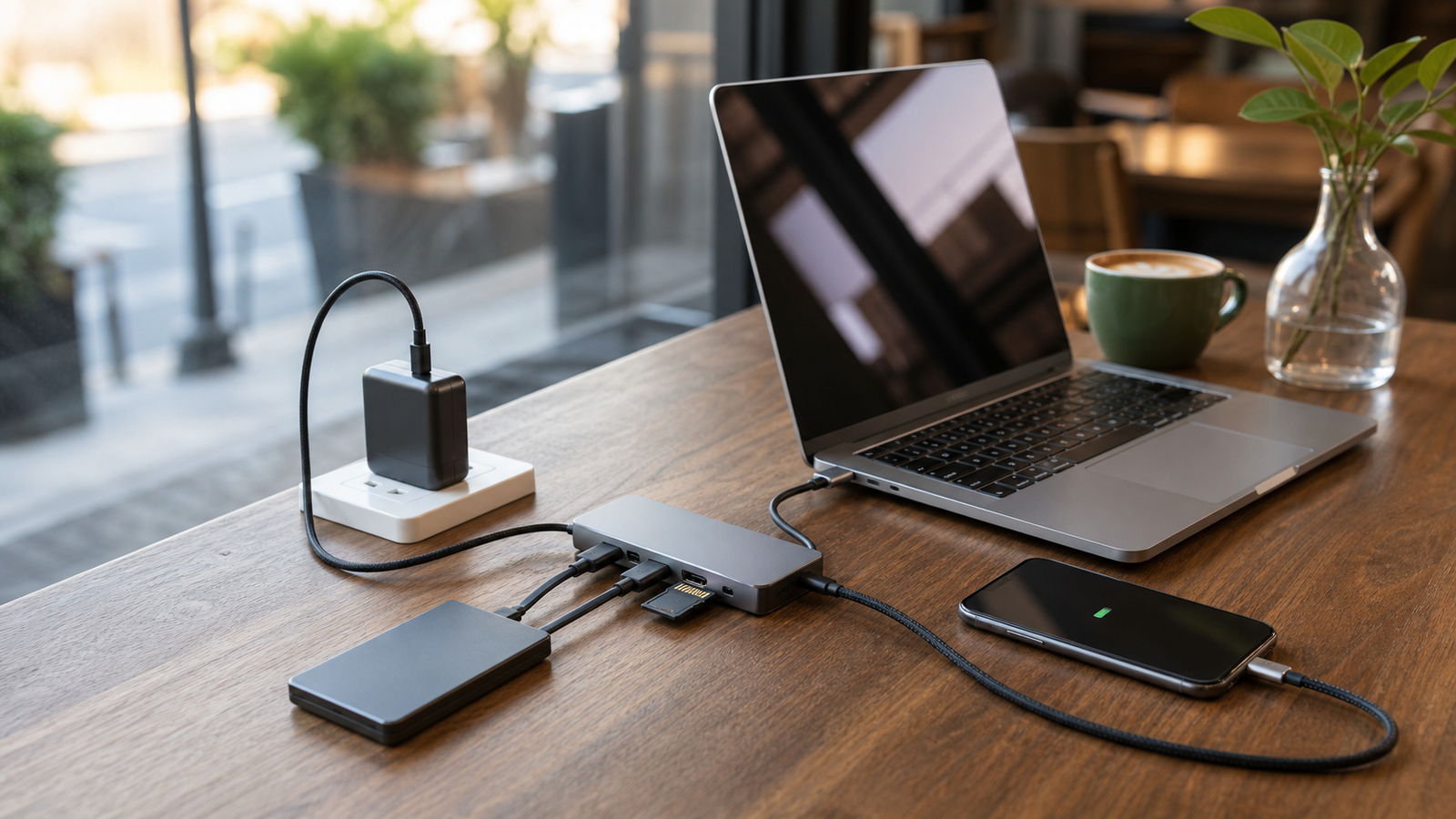
For years, the future of work was discussed in terms of location. Would people return to offices, remain at home, or divide their weeks between both? That debate missed a more interesting shift. Work is becoming less dependent not only on a particular office but also on a permanent collection of equipment. A laptop, a phone, a few carefully chosen accessories, and access to power can now turn a café table, hotel desk, airport lounge, or kitchen counter into a capable workstation.
Welcome to the one-cable economy: a world in which the smallest objects in a bag increasingly determine how productive, creative, and mobile we can be.
The Laptop Became Thinner—Our Needs Did Not
Modern laptops are elegant precisely because they leave so much behind. Optical drives disappeared first, followed by Ethernet sockets, card readers, and many full-size USB ports. The result is a lighter machine with better battery life and a cleaner silhouette. Yet the work surrounding that machine did not become simpler.
Photographers still need to transfer memory cards. Designers connect high-resolution displays. Analysts may need a wired network during a critical presentation. Remote workers charge phones, earbuds, tablets, and computers, often at the same time. The laptop shed its ports, but users inherited the responsibility of rebuilding them.
That trade-off explains why compact accessories now function as personal infrastructure. A thoughtfully selected USB C Hub can restore useful connections through a single laptop port, allowing one cable to link storage, displays, cards, networks, and other peripherals. It is less a computer accessory than a portable version of the office desk.
Power Is the New Workspace Currency
Connectivity is only half of the equation. The mobile workplace also depends on reliable power, and not all charging setups are equally useful. A low-output adapter may keep a phone alive but struggle with a laptop. Several separate adapters can do the job, but they consume outlets and quickly turn a light travel bag into a pouch of plastic bricks.
This is where the fast charger becomes more than a convenience. With suitable output, ports, cables, and device support, one compact unit may replace multiple adapters and shorten the time devices remain tied to the wall. Gallium nitride, commonly known as GaN, has helped manufacturers deliver substantial power from smaller enclosures, making high-output charging more practical for everyday carry.
Speed, however, should not be confused with one dramatic wattage figure. Charging is a negotiation among the power source, cable, and device. The maximum printed on an adapter is not automatically what every connected product receives. When several ports are in use, available power may be divided according to the charger’s design. The most useful question is therefore not “What is the biggest number?” but “Can this setup power my actual combination of devices?”
A Desk Is Becoming a State, Not a Place
The cultural impact of this equipment is easy to underestimate. A generation ago, serious computing was visually anchored to a place: a tower under a desk, a monitor on top, and a knot of cables behind it. Today, the identity of a workstation can travel with its owner.
That changes behavior. A consultant can arrive at a client site and connect to a display without requesting a drawer of adapters. A video editor can review footage while traveling. A student can move between a dorm, library, and classroom without maintaining three different charging kits. A small business can offer flexible seating without duplicating every peripheral at every chair.
In each case, the physical desk matters less than the ability to recreate a dependable digital environment. The workplace becomes a temporary state assembled on demand.
The Real Luxury Is Fewer Decisions
Technology marketing often celebrates having more: more ports, more watts, more screens, and more accessories. But the best mobile setup may be defined by how little attention it demands.
Good personal infrastructure removes micro-decisions. There is no morning debate about which phone adapter to pack. There is no hunt for a card reader before a trip. There is no moment of panic when a meeting-room display offers the wrong connector. The necessary capability is already in the bag.
This is a form of practical minimalism. It does not mean owning the fewest objects possible. It means choosing a small number of versatile objects that prevent clutter, duplication, and friction. A multiport charger can consolidate power. A hub can consolidate connectivity. A short checklist can consolidate preparation.
The result is not merely a tidier backpack. It is a calmer working day.
Read Also: The Future Of Technology In Certified Public Accounting
How to Build a Portable Workspace That Actually Works
The smartest kit begins with habits rather than specifications. List the devices you regularly carry, then note how each receives power and what it connects to. Someone who works mainly in documents may need charging, HDMI, and a wireless mouse. A photographer may prioritize card slots and fast storage transfer. A developer may value Ethernet, an external display, and enough power for a demanding laptop.
Next, check compatibility carefully. USB-C describes a connector shape, not a guarantee that every port supports the same data speed, display mode, or charging level. The host computer must support the functions a hub is expected to provide. Cables also matter: one designed only for basic charging may not handle high power, fast data, or video.
Consider power distribution under real conditions. If a charger will serve a laptop, tablet, and phone simultaneously, look beyond its total rating and examine how output changes when multiple ports are occupied. Allow some headroom instead of designing a kit that works only at its theoretical limit.
Finally, favor coherence over abundance. Extra ports are valuable only when they match genuine needs. An enormous dock can be excellent on a permanent desk yet awkward in a commuter bag. Conversely, an ultra-small hub may create frustration if it omits the one connection used every day. Portability is not simply small size; it is the right capability at a size worth carrying.
The Sustainability Case for Consolidation
The one-cable economy also raises an environmental possibility. If versatile accessories can serve several generations or categories of devices, people may buy fewer single-purpose adapters. Shared standards can reduce redundant equipment in homes and offices, while a well-planned charging station may occupy fewer outlets and require fewer power bricks.
That potential is not automatic. Cheap accessories that fail early simply create another waste stream, and buying every new port standard as soon as it appears is not sustainable. Durability, safety protections, repairability, and realistic long-term compatibility deserve as much attention as peak performance.
The greener accessory is often the one that remains useful after the next laptop upgrade.
From “Where Do You Work?” to “What Do You Carry?”
The most revealing workplace question may soon change. Instead of asking where someone works, we may ask what enables them to work anywhere. The answer will rarely be a single glamorous device. It will be a compact system: sufficient power, useful connections, dependable cables, and a routine simple enough to repeat without thought.
This shift does not make offices irrelevant, nor does it mean every surface should become a desk. It gives people more control over when and where focused work can happen. The technology fades into the background, which is exactly what good infrastructure should do.
The next revolution in mobile work may not arrive as a radically different computer. It may already be sitting beside one—quietly turning a single cable into power, ports, and possibility.